
Islam the religion
The Purpose of Life in Islam
What is the meaning of life? Why are we here? These are not small questions — and Islam does not give small answers. Here is what the Qur'an actually says, explained for anyone genuinely asking.
| THE QUESTION EVERYONE ASKS
Why Are You Here?
You are here because you are asking a question that philosophers, kings, and ordinary people have asked for as long as there have been human beings. What is the purpose of life? Why are we here? What is the meaning of life — not in the abstract, but for me, now, in the life I am actually living?
At some point — at a funeral, in a quiet moment, or when the life you were building suddenly felt hollow — most people feel it. A question that will not stay quiet. That feeling is not weakness. It is the most significant thing about you — a sign that you are paying attention to something built into human nature.
The Islamic view of purpose does not dismiss these questions or defer them to a later time. Islam answers them directly, from the first principles of its theology. What follows gives you that answer — not as a slogan, but as a complete way of understanding why you exist.
| THE QUR'ANIC ANSWER
What Is the Meaning of Life in Islam?
The Qur'an gives a direct answer to the question of purpose — stated plainly, without ambiguity, in Surah Adh-Dhariyat:
"And I did not create the jinn and mankind except to worship Me." Qur'an: Chapter 51, Verse 56
If you read that and felt a flicker of resistance — worship? That's it? — that reaction is worth taking seriously. Because the word translated as 'worship' here — ibadah, the Arabic term used in the original verse — is broader than its English translation suggests. In everyday usage, "worship" tends to be understood as formal ritual — structured prayer at set times, in a set place. In Islamic theology, ibadah encompasses every conscious act performed with awareness of Allah and in accordance with His guidance. It includes prayer, yes. But it also includes — among countless others:
| Column 1 | Column 3 | Column 4 |
| • How you speak to your parents | • How honestly you conduct your business | • How you support a friend in their hardest moment |
| • How you care for someone who is ill or elderly | • How you treat a stranger | • How you respond to grief |
| • How you help someone through a difficulty | • How you raise a child | • How you pursue knowledge |
The key is intention. The same acts, done without awareness of Allah, are simply good behaviour. But performed consciously for Him, they become worship — and they are counted. This is what "created to worship" means in practice: a life oriented toward the One who created it. The Prophet Muhammad ﷺ said: "Actions are judged by intentions." Sahih Muslim, 1907a The same act — working, helping, speaking — is either worship or mere habit depending on what it is oriented toward, and that is what the next section makes concrete — because ibadah is not a concept to understand. It is a life to live
| CLARIFYING A COMMON MISUNDERSTANDING
Worship Is Not Only Prayer




Caring for Others
Tending to a child, a parent, a spouse, or anyone in your care is one of the most sustained acts of worship a person can perform. Islam places the weight of a child's formation on those who raise them and does not treat that work as lesser than any other. Every meal prepared, every sleepless night, every moment of patient presence is seen and counted by Allah.

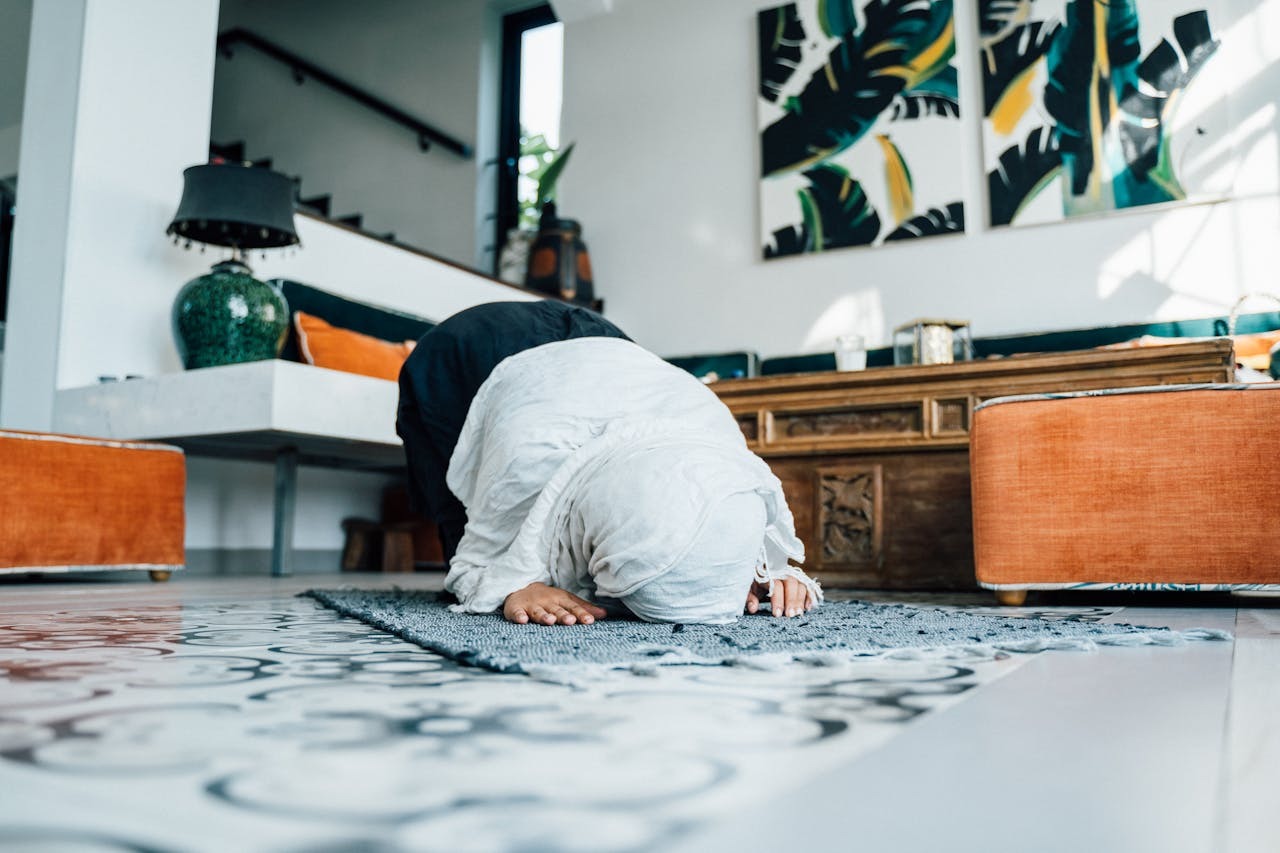
If this is true — and Islam says plainly that it is — then your life is not simply about passing time, building a career, or waiting for things to fall into place. Every decision, every interaction, every day you wake up carries weight that does not disappear when the day ends. The question is not only 'what is the purpose of life?' It is whether the life you are living right now is oriented toward it. Knowing what ibadah means changes how you see every hour of your day. Knowing why the choices are permanent changes how you see your whole life — and Islam does not leave that realisation without a door to walk through. → How to Convert to Islam
| THE DAILY FRAMEWORK
Life Is a Test — and Every Morning Is Another Opportunity
Islam is clear that life is a test — purposeful, temporary, and consequential. This is one of the most direct answers Islam gives to the question of why we are here, and the Qur'an is explicit about this:
"He who created death and life to test you — which of you is best in conduct." Qur'an: Chapter 67, Verse 2
The Qur'an also describes this life as brief. Not in a way designed to diminish it, but in a way designed to clarify it. When you understand that this world is temporary and the next is permanent, the hierarchy of what matters shifts completely.
"The life of this world is nothing but a game and a distraction; the Home of the Hereafter — that is the real life, if only they knew." Qur'an: Chapter 29, Verse 64
This is clarity — and it changes everything about how a day is lived. The person who genuinely understands this wakes up differently — not with anxiety — with direction. Islam gives you a reason to get up every morning, because every day is an unrepeatable opportunity to do something that counts permanently. The teachings of the Prophet Muhammad ﷺ make this concrete. These are not motivational phrases. They are authenticated statements that describe exactly what "passing the test" looks like in practice — in the smallest moments of an ordinary day. Read them slowly, and consider what it would mean to actually live inside this framework every single day.
"Whoever relieves a believer of one of the hardships of this world, Allah will relieve him of one of the hardships of the Day of Resurrection." Sahih Muslim, 2699a — narrated by Abu Hurairah (RA)
"The best of people are those who are most beneficial to people." Al-Silsilah Al-Sahihah, 426 — narrated by Jabir ibn Abdullah (RA), graded Sahih by Al-Albani
"When a person dies, his deeds come to an end except for three: ongoing charity, knowledge from which others continue to benefit, and a righteous child who prays for him." Sahih Muslim, 1631 — narrated by Abu Hurairah (RA)
"Allah is in the aid of His servant as long as the servant is in the aid of his brother." Sahih Muslim, 2699a — narrated by Abu Hurairah (RA)
"Make things easy and do not make them difficult. Give good news and do not drive people away." Sahih Bukhari, 6125
These are not motivational phrases — they are a complete description of what a life oriented toward Allah looks like in practice. The question is not whether you find them compelling. It is whether you are willing to try living inside them.
The Answer Invites a Response
You don't need to have everything figured out. You don't need to be perfect. You just need to be sincere — and willing to take a step. That step is not complicated.
CONTENT REVIEWED AND UPDATED BY THE ISLAMTHERELIGION.COM EDITORIAL TEAM — 2026